- Sep 3
G2G Is Now the P.E.A.C.E. Path
- Casey Cole Corbin
- 0 comments
For a long time, many of you have known my work through the language of G2G. Good to Great. That phrase has meant a lot to me over the years because it captured something I deeply believe: people are not usually broken beyond repair. Most people are not trying to ruin their lives. They are trying, often with outdated tools, to get from where they are to somewhere better.
But over time, I began realizing something. The deeper answer was never just “greatness.” It was peace.
Not passive peace. Not fake peace. Not “pretend everything is fine” peace. I mean the kind of peace that helps your nervous system settle, your identity reorganize, your choices become clearer, and your daily life begin to reflect the person you are becoming.
That is why G2G is now becoming the P.E.A.C.E. Path.
For nearly three decades now, I have used a little counselor trick with clients that I usually call the “six whys.” It is simple, but it almost always works. A client will tell me they want something, and when I ask why, the first answer is usually pretty surface-level. Not wrong, just surface. Then I ask, “Why is that important?” and they go a little deeper. Then I ask again. And again. Usually, after asking why several times, we finally get beneath the goal, beneath the strategy, beneath the fear, beneath the image they are trying to maintain, and we find the thing they were really reaching for all along.
For example, a client might say, “I want to make more money.”
So I ask, “Why?”
They might say, “Because I want to feel more secure.”
“Why is it important to feel more secure?”
“So I can know I would be okay if there was a financial emergency.”
“Why is it important to know you would be okay?”
“So I can feel safer.”
“Why is it important to feel safer?”
“So I can be calmer around my family.”
And eventually, if we keep going, we almost always arrive at the same place.
Peace.
I do not mean occasionally. I mean always. The final answer, the thing underneath the thing underneath the thing, is peace. People want money, success, love, healing, discipline, confidence, forgiveness, clarity, better habits, healthier relationships, freedom from addiction, emotional control, a stronger marriage, a better career, or a second chance. Those are real desires, and many of them matter deeply. But most of the time, those desires are not the final destination. They are the means people believe will finally get them to peace.
That is the million-dollar question hiding underneath almost every problem: “What am I really trying to get to?”
And if that is the million-dollar question, here is the shortcut to the million-dollar answer: you do not have to wait for everything else to happen before you begin allowing peace today.
That does not mean your circumstances do not matter. Of course they do. Money problems matter. Marriage problems matter. Grief matters. Addiction matters. Anxiety matters. Betrayal matters. Family stress matters. Your body, your history, your relationships, your responsibilities, and your real-life pressures all matter. Peace does not ask you to deny reality. Peace helps you meet reality differently.
That is why I wanted the new language to be body-based, not just brain-based.
A lot of people know things they cannot live yet. They have read the book, heard the sermon, taken the course, listened to the podcast, saved the quote, and underlined the paragraph. They understand the idea. But when the nervous system gets activated, information alone often disappears. You do not rise to the level of your best quote when your body is in survival mode. You usually fall back into the pattern your body knows best.
That is why the P.E.A.C.E. Path is not just a teaching. It is an implementation process.
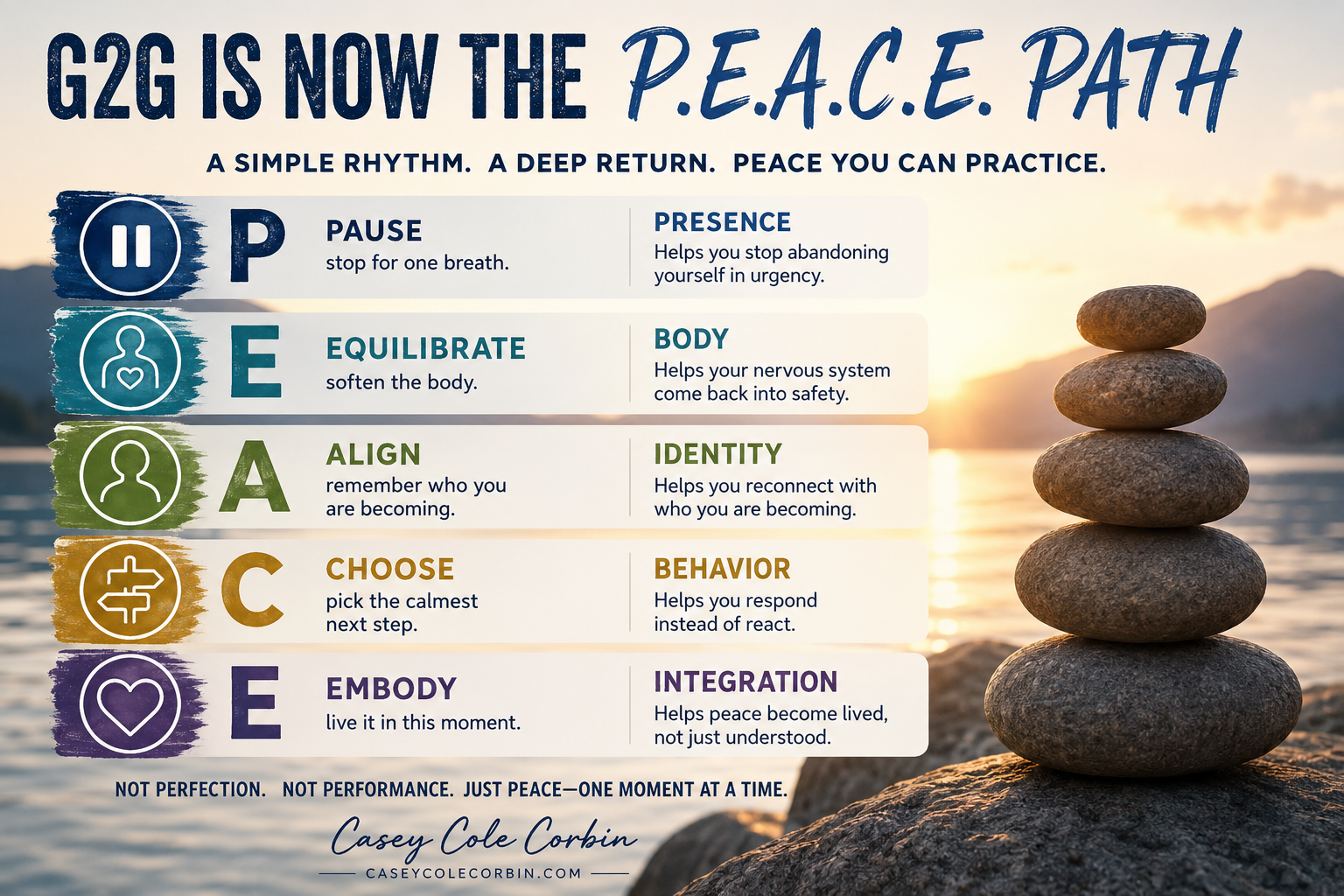
Here is the tiny rhythm:
Pause — stop for one breath.
Equilibrate — soften the body.
Align — remember who you are becoming.
Choose — pick the calmest next step.
Embody — live it in this moment.
That may sound simple. It is. But simple does not mean shallow.
Pause interrupts the reaction. Before you send the text, make the accusation, shut down, over-explain, numb out, spiral, or run back into an old pattern, you pause. Not forever. Sometimes just one breath is enough to create a small space between the trigger and the reaction.
Equilibrate helps your emotions settle. This is where you help your nervous system come back into a little more safety. You soften your shoulders. You unclench your jaw. You notice your breath. You stop treating every feeling as an emergency. You remind yourself, “A part of me is activated, but all of me is not this reaction.”
Align brings you back to who you are becoming. This part matters because most people do not only need a better decision. They need a better identity to make the decision from. If I see myself as powerless, rejected, unsafe, unwanted, behind, broken, or doomed, I will choose from that identity. But if I can remember who I am becoming, even for a moment, I may have access to a different response.
Choose gives you clarity instead of impulse. This is not about controlling everything. It is about asking, “What is the calmest next step available?” Not the perfect step. Not the most impressive step. Not the step that proves I am healed. Just the next peaceful, responsible, aligned choice.
Embody turns peace into practice. This is where peace becomes more than something you believe in. It becomes how you breathe, how you speak, how you pause, how you repair, how you rest, how you work, how you set boundaries, how you tell the truth, and how you return when you drift.
Another way to remember it is by the area each part affects.
Pause is presence. It helps you stop abandoning yourself in urgency.
Equilibrate is body. It helps your nervous system come back into safety.
Align is identity. It helps you reconnect with who you are becoming.
Choose is behavior. It helps you respond instead of react.
Embody is integration. It helps peace become lived, not just understood.
So the easier memory track becomes:
Pause — Presence
Equilibrate — Body
Align — Identity
Choose — Behavior
Embody — Integration
Presence. Body. Identity. Behavior. Integration.
That is what the P.E.A.C.E. Path is really working on. It is not merely trying to help you think better thoughts. It is helping you become the kind of person who can experience a feeling without becoming the feeling, notice a pattern without collapsing into shame, make a choice without being dragged by urgency, and build a life where peace is not constantly postponed until every problem is solved.
I have to admit, I needed someone to help me with this throughout my entire life. In a way, I have always had coaches. I have always needed mirrors, guides, structure, accountability, and people who could see something in me when I was too close to my own pattern to see it clearly. That is part of why I coach others the way I do now. I know what it is like to need help returning to yourself. I know what it is like to understand something intellectually and still need support implementing it in real life.
Clients come to me with an infinite variety of “problems.” I put that word in quotes not because the problems are not real, but because the presenting problem is usually only the doorway. Someone comes in because of marriage stress, anxiety, anger, self-sabotage, procrastination, addiction patterns, money fear, parenting pain, grief, rejection, confidence, boundaries, or a major life decision. Those are all different doorways. But underneath each one, we are usually looking for the specific path of peace that person needs to implement with accountability, structure, and support.
That is the difference between information and transformation.
Information says, “Here is what peace is.”
Implementation says, “Let’s practice returning to it when your body wants to run, fight, freeze, perform, please, hide, control, explain, or collapse.”
That is why G2G is becoming the P.E.A.C.E. Path. The destination was always deeper than achievement. The work was always more than self-improvement. The goal was never to help people perform growth. The goal was to help people return to themselves and live from a more peaceful, honest, responsible, aligned place.
You do not have to wait until the money is perfect, the relationship is perfect, the past is resolved, the anxiety is gone, the habit is fixed, or the future is guaranteed before you begin practicing peace.
You can begin with one breath.
Pause.
Let your body soften.
Equilibrate.
Remember who you are becoming.
Align.
Ask for the calmest next step.
Choose.
Then live that one small piece of peace in this moment.
Embody.
That is the path.
Not perfection. Not performance. Not pressure.
P.E.A.C.E.
-Casey
If you are wondering where your own peace gets interrupted, I created a free 3-minute assessment to help you identify your go-to change pattern.
You may be a Distancer, Relief Seeker, Prover, or Certainty Seeker — and once you can see the pattern clearly, you can begin working with it more peacefully.
You can take the free assessment on my main page here:
https://www.caseycolecorbin.com
And if you want deeper support after that, NOW: Control Your Emotions is the next step for learning how to slow the reaction, understand what your emotions are doing, and return to choice in the present moment: