- Aug 11
Where am I on this journey, and what would help me move forward?
- Casey Cole Corbin
- Self-Sabotage VS Abundance
- 0 comments
From Autopilot to Alignment:
There are certain truths I keep finding again and again from different teachers, traditions, counseling rooms, spiritual awakenings, painful seasons, personal growth work, and my own repeated need to learn the same lesson at a deeper level. The words change. The maps change. The stages get named differently. But the pattern keeps showing up. We begin life open, then we get programmed, then we mistake the programming for ourselves, then life starts trying to wake us up.
That is the frame I want to use here. Not as a rigid ladder. Not as one more personality test. Not as a spiritual scoreboard where you get to decide you are more evolved than your cousin at Thanksgiving. Please don’t. The point is much more useful than that. The point is to ask: where am I on this journey right now, what has me stuck, and what would help me take the next honest step?
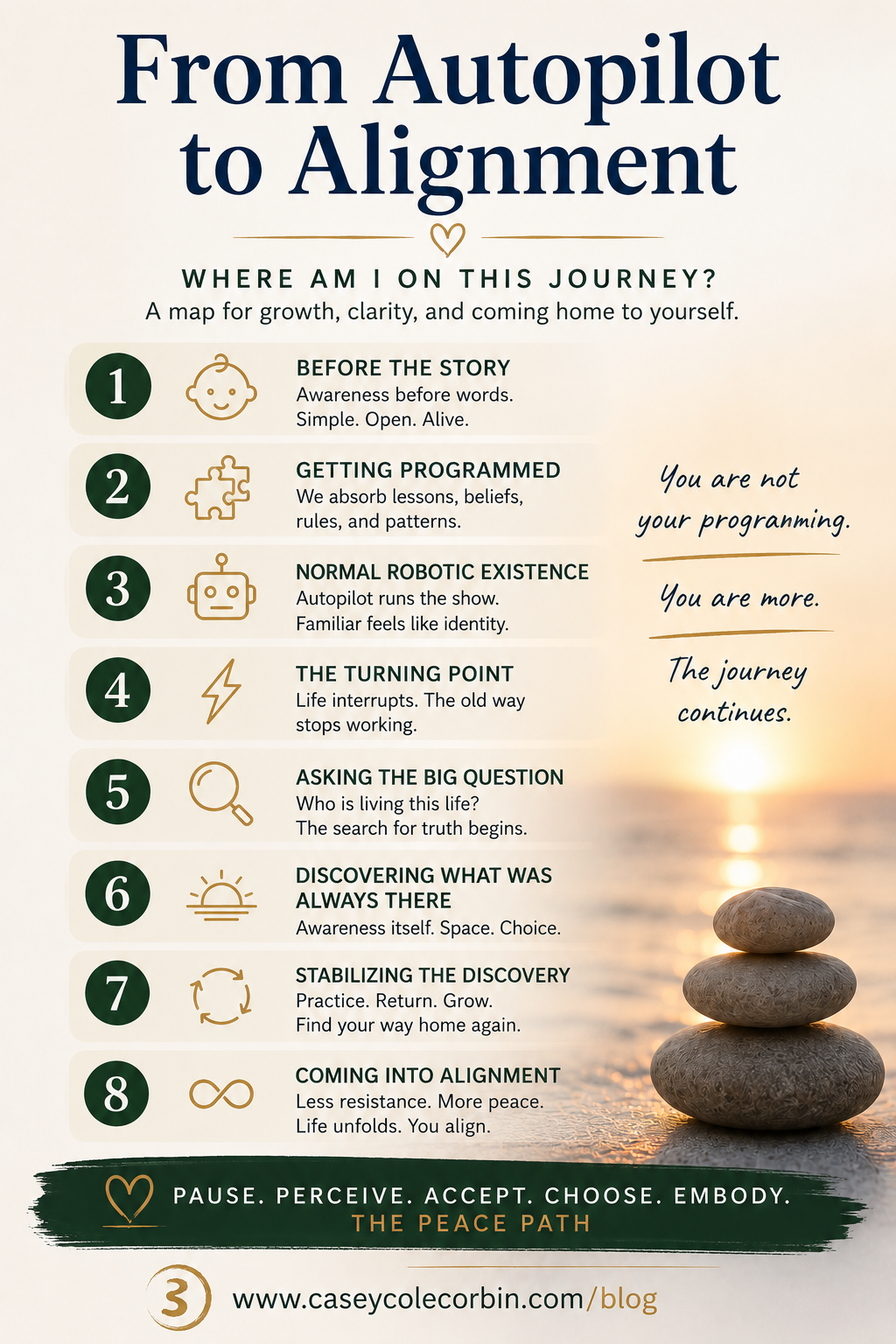
1. Before the Story
We begin before we have language for ourselves. A baby sees, hears, feels, tastes, reaches, cries, rests, reacts, receives. There is awareness before there is a fully formed self-story. There is experience before there is “my experience.” Of course, we do not stay there in the same innocent way, and we are not trying to become infants again. I have enough trouble finding my keys as an adult. But there is something important here. Before you were your wounds, roles, opinions, defenses, ambitions, and anxieties, you were simply alive and aware.
That matters because many people come to believe their current story is their deepest identity. I am anxious. I am broken. I am too much. I am not enough. I am a failure. I am the responsible one. I am the rejected one. I am the strong one. I am the one who always has to make everything work. Some of those labels may describe experiences you have had or patterns you have learned, but they are not the whole truth of who you are. You are older than the story you learned to tell about yourself.
2. Getting Programmed
Then life starts programming us. Some of that is good. We learn language, attachment, manners, safety, discipline, skills, faith, culture, and hopefully enough hygiene to be invited back places. But we also absorb fear, shame, family rules, religious distortions, social pressure, emotional patterns, money beliefs, relationship expectations, body anxiety, and the unspoken lessons of whatever environment raised us. Programming is not just what people taught you; it is what life trained you to expect.
This is where many adult problems begin. You may think you are making free choices, but often you are responding from old instructions. You pick the same kind of relationship. You sabotage the same kind of opportunity. You overwork for approval. You avoid conflict. You chase intensity and call it love. You stay small and call it wisdom. You keep trying to earn safety from people who cannot give it. The program keeps running until you learn how to notice it.
3. Normal Robotic Existence
This is the stage most of us know too well. You go to work. You pay bills. You buy groceries. You manage relationships. You do adult things. You look like you are choosing. Sometimes you are. But a lot of life can run on autopilot while still feeling very personal. The programming becomes so familiar that we call it personality. Autopilot feels like “just who I am” when it has been running long enough.
This is where people can become successful and still not be free. You can build a business from old programming. You can marry from old programming. You can parent from old programming. You can serve, lead, preach, counsel, perform, and achieve from old programming. That is why success alone does not equal maturity. You can be impressive and still be unconscious.
The question here is simple: where are you functioning, but not really awake? Where are you reacting in predictable ways while telling yourself you are choosing? Where does your life keep producing the same emotional result, even when the circumstances change? Repeated outcomes usually reveal a repeated pattern.
4. The Turning Point
At some point, something interrupts the trance. Sometimes it is dramatic: a death, divorce, diagnosis, betrayal, job loss, relapse, burnout, health scare, or public failure. Sometimes it is quieter: you wake up one day and realize the life you built is technically working but your soul is not impressed. Either way, something in you starts saying, “This cannot be all there is.” A turning point begins when the old way stops being believable.
The turning point is uncomfortable because it disrupts the familiar story. You may not know what comes next, but you begin to suspect that continuing exactly as you are is going to cost too much. This is also where people often try to rush back to normal. They want the pain to stop, the relationship to settle, the body to behave, the business to stabilize, the faith questions to quiet down, and the anxiety to go back in its drawer. But sometimes the disruption is not the problem; sometimes the disruption is the invitation.
This is a good place to ask: what is life using right now to get my attention? Is it my body? My marriage? My business? My children? My aging parents? My anxiety? My resentment? My lack of joy? My exhaustion? The turning point does not always feel spiritual. Sometimes it just feels inconvenient and rude.
5. Asking the Big Question
Eventually the question deepens. It is no longer only, “How do I fix this problem?” That question matters, but it is not always deep enough. The larger question becomes, “Who is living this life?” Who am I underneath the roles, reactions, memories, fears, beliefs, strategies, wounds, and performances? At some point, maturity moves from behavior management to identity inquiry.
This stage can feel disorienting. You may realize you do not know yourself as well as you thought. You may notice that much of what you called “me” was actually adaptation. You may see that your anxiety, ambition, anger, people-pleasing, control, or emotional shutdown had a history. That does not mean you are fake. It means you are becoming honest. Sometimes “I don’t know who I am” is not failure; it is the first truthful answer.
This is where the PEACE Path becomes very practical. Pause long enough to stop the automatic pattern. Examine or perceive what is really happening. Accept reality without drowning in shame. Choose the next grounded step. Embody the new way through actual practice. Peace is not found by thinking about change; peace grows as you practice a different response.
6. Discovering What Was Always There
As you keep paying attention, you may begin to discover something deeper than the program. Call it awareness. Call it the higher self. Call it your truer self. Call it the image of God underneath the false self. Use the language that fits your framework. I am less concerned with the label than the movement. There is a part of you that can observe the pattern without being completely owned by it.
That discovery matters because it gives you space. You can notice anger without becoming anger. You can notice fear without obeying fear. You can notice shame without letting shame write the whole script. You can notice the old program activating and say, “Ah, there it is.” That little bit of space is powerful. What you can observe, you are no longer completely controlled by.
This does not mean you suddenly become peaceful forever and start floating through grocery stores radiating enlightenment near the frozen vegetables. Real life remains real life. People still say things. Bodies still age. Families still family. Businesses still produce decisions you did not want to make before lunch. But something changes when you realize you are more than the reaction. Freedom begins as a gap between stimulus and response.
7. Stabilizing the Discovery
Seeing something once is not the same as living from it consistently. You may have a beautiful moment of clarity and then lose your mind because someone used the wrong tone in a text message. Welcome to humanity. The discovery has to stabilize. You find your way home, then you get pulled away, then you find your way home again. Growth is often the shrinking distance between getting lost and returning to yourself.
This is where practice matters. This is where counseling, coaching, prayer, meditation, journaling, boundaries, community, nervous system work, honest conversations, and real-life application become necessary. Insight feels clean. Practice is messier. But practice is where maturity becomes embodied. You do not stabilize peace by admiring it; you stabilize peace by returning to it repeatedly.
Ask yourself: what helps me come back to myself? What knocks me off center? What patterns still hijack me? What support would help me practice the next stage instead of just understand it? The next step is usually less mysterious than we want it to be. It is often the thing we already know we need to practice.
8. Coming Into Alignment
Alignment does not mean life becomes easy or you stop having feelings. That would be nice, but suspicious. Real alignment means you are less divided inside. You are not spending as much energy arguing with reality, defending old programming, performing an identity, or trying to force life to validate your wounds. Alignment is cooperation with what is true.
This is where peace becomes less performative and more natural. You still make choices. You still set boundaries. You still grieve, build, love, work, repair, and sometimes say, “Absolutely not,” with your full chest. But you are less likely to abandon yourself in the process. You are less driven by old programming. You are more able to respond from presence. Maturity does not make you less human; it makes you more honestly human.
And there is no finish line where you get a certificate and never have to deal with yourself again. Sorry. I would also like that package. Alignment keeps unfolding because life keeps unfolding. The goal is not to arrive at some polished spiritual image. The goal is to become more awake, more honest, more loving, more grounded, and more free. The journey continues because life keeps inviting deeper alignment.
Where Are You Right Now?
The useful question is not “What stage can I brag about?” The useful question is, “Where am I right now?” Maybe you are waking up to old programming. Maybe you are in the middle of a turning point. Maybe you are asking the big identity question. Maybe you have had moments of clarity but cannot stabilize them yet. Maybe you are trying to live from peace while ordinary life keeps testing your operating system. Naming where you are helps you stop judging yourself for not being somewhere else.
Then ask the next question: what would help me make progress? Do I need to stop pretending I am fine? Do I need support? Do I need to tell the truth about a relationship, habit, business structure, body signal, or spiritual dryness? Do I need to practice pausing before reacting? Do I need to stop confusing survival strategies with identity? Getting unstuck usually begins by telling the truth about the actual stuck place.
And finally: why keep going? Because autopilot may be familiar, but it is not freedom. Because the programming may be strong, but it is not your deepest self. Because peace is possible in ways you may not have fully experienced yet. Because your life can become more aligned, more honest, more grounded, and more alive than the old story allowed. The next stage is worth pursuing because you are worth recovering from the programming that has been running you.
A Question for You
Where are you on this journey right now? Are you recognizing old programming? Experiencing a turning point? Asking the bigger question? Trying to stabilize peace in real life? Reply and tell me which part feels most true right now. I read those replies.
If this made you wonder where you are on the journey right now, that is exactly why I created NOW: Control Your Emotions. It is a simple $7 brief online experience designed to help you stop being run by old programming, emotional reactivity, anxiety, and autopilot responses. You can read the material, listen to the audio, and use the AI Companion / PEACE Bot to help you apply it personally. For now, NOW: Control Your Emotions is only $7.
Start here:
https://www.caseycolecorbin.com/now-control-your-emotions
-Casey
Credit: The concise eight-stage list that helped organize this reflection came from Don Oakley’s teaching on the Eight Stages of Human Maturity. The reflections, applications, and PEACE Path framing here are my own, gathered from many sources, years of client work, and plenty of my own growth lessons.
PS: Members get the NOW: Control Your Emotions for free.